Thursday, December 17, 2015

Tully experiences

Apart from the work Christel did with the children’s schoolwork and my efforts in the hospital we had a number of great experiences. Further to Christel’s latest blog update. Worth mentioning by me are our 2 boating trips exploring the “family islands” and 2 dive trips I did with our local GP in town.
 On our first boating trip we had a general wander around the islands. The Islands of the family group are true castaway deserted islands with little bays of clean sand, blue water and hills rising up from them.  Moring in these bays and exploring the beaches was a gorgeous experience. To be able to dive off the back of the boat, swim the warm salt water to the beach and to walk the shoreline is an experience dreams are made off.  
We do a spot of fishing between the islands and manage to catch a delicious spotted mackerel.  The bay we caught him in was soon named “mackerel bay”.  
Because of recent strong winds the water is not clear enough to go snorkeling on the fringing reefs but clear enough for our kids to do target practice on air filled balloons with spear guns.  It turns out slightly trickier then they thought.  Between the pod of whales, the fish, the spearing and overall experience of the islands we had a great day.

On our second trip out we follow a very similar route out around the islands.
The water is a bit clearer and we have a go at snorkeling and spearfishing, first for balloons and later for fish. There are lots of large fish about and I manage to shoot a few. I could have taken more, however I don’t know what they are and if they can be eaten at all let alone taste well.  The lady’s at reception of the hospital between them tell me that they are most likely “mother in law” fish.  Turns out they taste very nice. I cooked them up on the barbeque with a sprinkling of Chicken spice rub. Nice firm flesh. Even Laura thinks it is doable.
We collect some nice shells from the beaches and Laura makes a very nice art work with them.  
All children have a go at steering the boat again, which they love almost as much as me.


I get invited to come diving twice. On our first trip we are 4 divers and will try to find a shipwreck and a sunken crane. David, the local GP, is a very active diver who goes out most weekends, weather permitting. He has a regular dive buddy Jye who is also training him for deep deep diving. (75meters +).  I buddy up with a dive instructor from Cairns. 
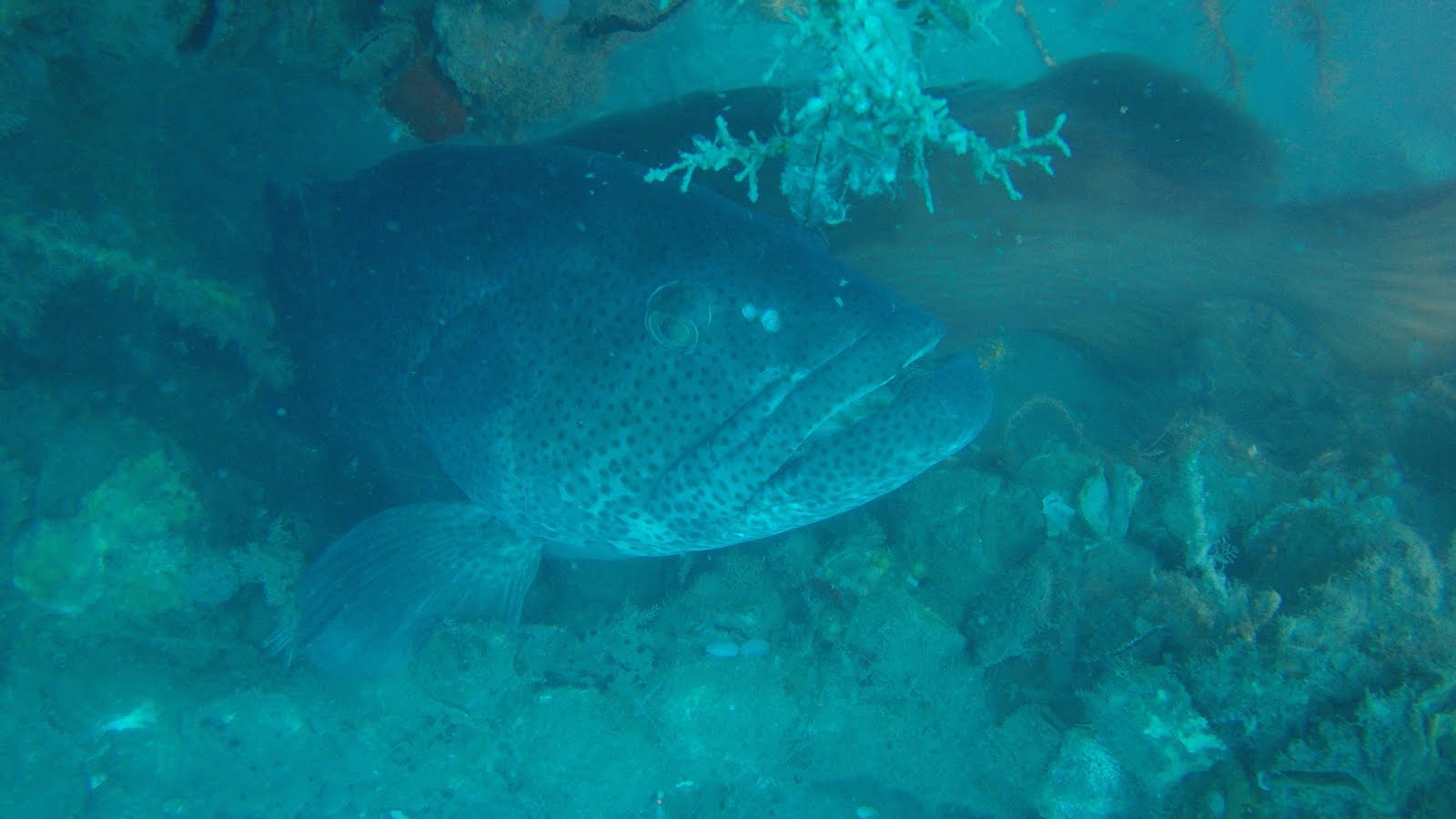
All being experienced divers the atmosphere is very relaxed and that makes for excellent diving. David was given coordinates of a sunken fishing vessel and although we search for the ship on the sounder for some time we do not see it. Plan B is to drop the anchor and do a circular search with a 100meter rope around the anchor. It takes 20 minutes to find it but find it we do. The visibility is good and it is accelerating to see the wrack materialize before us. The wrack is home to a very large Queensland Groper (2+ meter).  Due to its depth (35 meters) there is no spear fishing on the wrack and we see lots of large fish like Cod and Coral Trout.  
The second dive of the day is on a crane that dropped over the railing of a barge in rough weather. The sounder picks this up quickly and we drop straight onto it. The crane lies is 25 meters of water. Shallow enough for experienced spear fishermen to dive on. There is less large fish here but we do find a beautiful cray fish.
I made a gopro movie of the dive for anyone who cares to look at 5 minutes of blue fishy screen.
Our second day diving is 2 weeks later. Another beautiful day. We first spot a pod of whales and then make it to a small sand cay on the edge of the outer reef. We are awaiting skydivers who are planned to land here sometime today. After a good 1 hour wait we decide to move to our first dive site; a rock wall going down to 40+ meters. David first does some exercises with Jye for his deep diving certificate. I spend that time snorkeling the amazing reef shallows. 
Then we take to the deeper water. The chances are that we see some really big pelagic fish like Marlin (which Jye and David saw some weeks ago).  Alas no big fish here. The dive is very nice again as diving always is.  
We make our way back to the sand cay and watch about 20 people falling from the sky and land on this small stretch of sand. Do they feel as free up there as I do in the sea below? 
The second dive is on one of the most famous wracks on the coast here, the Lady Bowen. It is sea snake city down here. Every few minutes a snake surfaces to get a breath of air before swimming back down to the wreck 30 meters below. Some of the most poisonous snakes in the world share this wreck with us. As poisonous as they are they are also the most docile you will ever meet. No need to be afraid.  The wrack has a beautiful swim through full of fish and lots of things grow onto its surface.  I try a spot of fishing once back onto the boat but have no luck hooking into any of the fish that where so prolific down below.

7 weeks in Tully

Jolmer has landed locum work with Queensland health and takes us to Tully for seven weeks. The hospital work is a nice mix of ward rounds, emergency medicine and plenty of GP work. We are offered a place to stay. It is a lovely house on a hill side with a driveway big enough to host our trailer and bus.
The house has two stories, as with many hill side houses, and features an interesting building technique. The top level floor is the bottom level’s ceiling. The whole house thus becomes one big instrument with sounds resonating and reverberating all through the open space of the basement garage. Mainly the old washing machine produces a lot of music. The children enjoy playing outside with the neighbours. We get a lot of school work done. And to be quite honest: it is nice to be able to spread our family out in a house with multiple bedrooms.
Settling in is not hard at all. Jolmer is quickly introduced and at home at the hospital. Twice in the first fortnight does a stranger, twice at the Post office, pull me up asking if I am Jolmer’s wife. Something gives us away, possibly the large tribe and us speaking Dutch.
Tully is Australia’s wettest spot; the annual rainfall can be up to 8m in a record year. To celebrate this much rain, the council of Tully has erected an eight metre high golden gumboot, which you can climb.
The other important reason of existence for Tully is its sugar industry. Three large steam spitting chimneys dominate the town’s skyline.
Shopping in Tully can also be remarkably rewarding. In the local newsagent I buy a 1000-piece puzzle, which gets finished in three nights. The toyshop sells spy-glasses, the Tackle world fishing gear shop has everything else one could possibly desire, but you’d have to ask Jolmer more about that. At least we bought some sting suits for the nearing stinger season.
One afternoon in week 2 after we finished our quick run through Tully’s super IGA, Tim needs to go to the toilet. We decide to pay a visit to the information visitor’s centre. Always helpful, and not just for the public toilets. They have a display about cyclone Yasi. It hit Tully badly in 2011. With arms full if information we leave. On our way back to town we spot a fresh fruit stall. While buying delicious fruits we discover a pavilion on the local sports ground with open doors revealing a Gym&Tramp club. It turns out we can join. Thursdays is for the older children, Mondays for the younger kids. Peter is lucky, I am counting him in both groups, advantage for the middle child.
They love running, swinging on the trapezium, the bars, balance beam, but most of all they love jumping on the big trampolines.
The local pool is also a discovery worth mentioning. Apparently the water is very cold so the first time I go there I pack two wet suits for the youngest, because they cool down so quickly. I must have forgotten that we are in tropical Queensland because the pool water is actually 26 degrees, no wet suits needed, at all. The locals find it too cold still, but to us the water is just divine.
Tim improves on his swimming a lot –getting three lessons per week helps- and is able to finish his Dutch A-diploma in swimming skills. He is ecstatic.
 Not far from Tully is Mission Beach, one of the more famous beaches of Queensland. We are fortunate to be able to borrow a boat from one of Jolmer’s colleagues. Islands just off shore are calling us, they need exploring, the sea needs fishing, the shells need collecting and even a pod of whales is calling us, they just need to be admired. This is living.
Another colleague invites us to a tour on their Tropical Fruit Farm. We see and taste fruits we have never heard of. The farm is recovering from Yasi, trees are restoring themselves. The whole farm is fascinating as well as delicious.
Speaking of colleagues, the medical superintendent for the region is someone we know from our former training provider, and he invites us to come over to his house in the hills north of Innisfail. Talking about living. There is the house, the pool, and a guesthouse where we can all stay. Funny enough he also has one daughter and four sons in different age groups and we enjoy a lovely get-together-with splendid views over Queensland’s hills.

After all school work is done for term 3, we have some time to enjoy Alligators Nest, a small creek and swimming hole with tiny rapids, part of Tully Gorge National Park. It has a large grassy area and public barbeques. What is not to like? Even with Jolmer being at work we manage to make ourselves eggs in a hole on the BBQ plate. All else we need apart from our swim suits is a cricket set and a frisbee.
Fathers day gives a good opportunity to make some block art.
Tim has his birth day and requests a castle cake. You ask we deliver.....
The opportunity to learn more about Queensland’s sugarcane industry is not lost on us. Jolmer takes the oldest three on a mill tour and learns that the steam produced in the heating process generates enough electricity to run the mill as well as 5000 house holds. All by-products have a purpose, including producing fertilisers for next year’s crops. We visit the sugar museum in Innisfail to learn about the history of the industry, the harsh working conditions, and the pacific Islanders who were brought over to work under dubious circumstances.
And to finalise our education we are invited to sit on a sugar cane harvester: a mean piece of engineering. Fantastic to see how the large cane stalks are pulled in straight to get chopped at ground level and mulched into smaller pieces. Magnificent. Considering sugar cane is a grass, this must be the world’s most complicated and largest lawn mower!

Time comes to pack all our stuff back into the bus. The hospital sends a team of three professional cleaners to shine and buff the house for the next locum. Words cannot express how spoiled I feel by the presence of these wonderful ladies. One last silly thing though: after seven weeks we have not seen Tully gorge so before we can head south, we must rectify this. We spend an extra night at Alligators Nest, so we can visit the gorge the next morning. March flies are out since a week or two and they make our expedition to the gorge slightly challenging. I am a bit underwhelmed with the gorge, probably because I go about it the wrong way. White water rafting is the right way, for sure. Bus loads of young people (in their 20’s) are dropped off at the top of the gorge, they will have a good time for sure.
On our very last drive back to Tully Jolmer spots a cassowary. By the time I break and turn the car around the bird is unfortunately gone. However , it’s good to know that here on the Cassowary Coast, there are cassowaries to be found.

We shall miss the tropical fruits, the bananas you don’t find in supermarkets, the early morning showers on the roof top of the loud house, and the lush green rain forest.